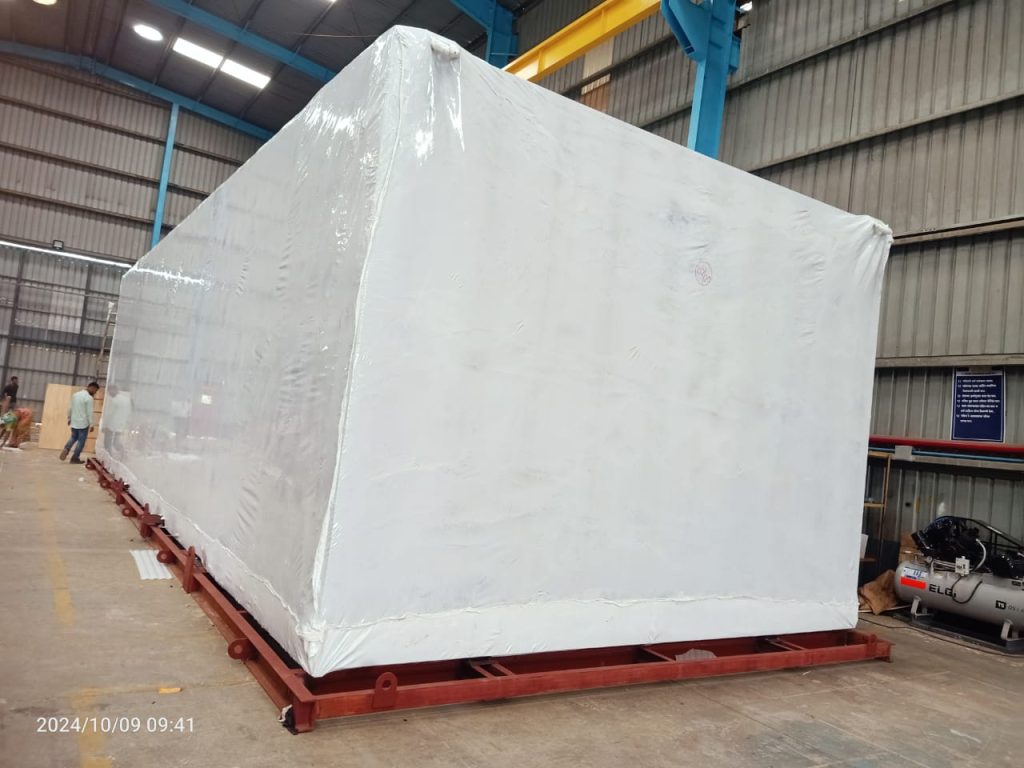
Procurement and plant managers often default to wooden crates for heavy or high-value industrial shipments, assuming they offer the only viable protection. Meanwhile, teams shipping lighter components in corrugated boxes may face damage claims that erode cost savings. The reality is more nuanced: the optimal packaging solution depends on weight, transit mode, compliance requirements, and total landed cost. Below is a fact-based framework to determine when each material makes sense—and when a hybrid approach may deliver the best balance.
Strength and Load Capacity
Wooden crates provide superior structural integrity for heavy or irregularly shaped loads. A standard 18 mm plywood crate can support static loads of 1,000–1,500 kg when properly braced, while hardwood crates (e.g., 25 mm thick) can exceed 2,000 kg. Crates are also better suited for lashing: ISO containers typically allow 2,000–2,500 kg per lashing point, but corrugated boxes are limited to 500–800 kg due to the material’s lower tensile strength.
Corrugated boxes, by contrast, are designed for lighter, uniformly distributed loads. A triple-wall corrugated box (e.g., 1,100 GSM with BC flute) can handle 200–500 kg when stacked, but performance degrades with sharp edges or concentrated weight. For dense, cube-shaped components (e.g., automotive castings or electrical enclosures), corrugated may suffice if palletized and stretch-wrapped to distribute load.
Compliance and International Shipments
Wooden packaging used in international trade must comply with ISPM 15, which mandates heat treatment (56°C for 30 minutes) or methyl bromide fumigation to prevent pest transmission. This adds 24–48 hours to lead time and increases cost by 10–15%. Corrugated boxes, being manufactured from processed pulp, are exempt from ISPM 15, making them simpler for cross-border shipments.
However, some countries impose additional restrictions. For example, Australia and New Zealand require wooden crates for certain machinery imports to mitigate biosecurity risks, even if the shipment originates from an ISPM 15-compliant facility. Always verify destination-specific regulations before selecting packaging.
Cost and Lead Time
Corrugated boxes are typically 30–50% cheaper than wooden crates for equivalent volume, though the gap narrows for custom designs. A standard 1,000 x 1,000 x 1,000 mm wooden crate costs ₹8,000–₹12,000, while a triple-wall corrugated box of the same dimensions ranges from ₹3,500–₹6,000. Lead times also differ: corrugated boxes can be produced in 3–5 days, whereas wooden crates require 7–10 days due to material sourcing and fabrication.
Cost savings from corrugated must be weighed against potential damage claims. For example, a 5% damage rate on ₹1 crore of shipped components equates to ₹5 lakh in losses—often enough to justify upgrading to wood or a hybrid solution.
When Each Material Is Mandatory or Sufficient
Wooden crates are mandatory or strongly recommended for:
- Machinery or equipment exceeding 500 kg, where lashing and vibration resistance are critical.
- Shipments with sharp or protruding components that could puncture corrugated.
- Multi-modal sea transit, where humidity, salt corrosion, and stacking loads exceed corrugated’s limits.
- High-value items where damage risk outweighs cost (e.g., precision CNC machines).
Corrugated boxes are sufficient for:
- Lighter components (under 200 kg) with dense, uniform packing (e.g., automotive fasteners or electrical relays).
- Frequent shipment cycles where return-trip damage tolerance is low (e.g., just-in-time supply chains).
- Domestic road or air freight, where transit stresses are lower than sea or rail.
- Items where weight reduction is prioritized (e.g., aerospace components).
Hybrid and Middle-Ground Solutions
For shipments that don’t neatly fit either category, hybrid approaches can balance cost and protection:
- Corrugated inserts in wooden crates: Use corrugated dividers or cushioning inside a wooden frame to reduce weight while maintaining structural integrity. Common for automotive powertrain components.
- Plywood-faced crates: A compromise between wood and corrugated, plywood-faced crates (e.g., 6 mm plywood on a light wooden frame) reduce weight by 20–30% while meeting ISPM 15 requirements. Suitable for 300–800 kg loads.
- Corrugated-on-pallet with stretch wrap: For 200–500 kg loads, triple-wall corrugated boxes palletized and stretch-wrapped can mimic the rigidity of a crate at lower cost. Requires proper load distribution to avoid crushing.
Comparison Table: Wooden Crates vs Corrugated Boxes
| Factor | Wooden Crates | Corrugated Boxes |
|---|---|---|
| Weight Range | 500–2,500+ kg | Up to 500 kg (optimal under 200 kg) |
| Transit Mode | Sea, rail, multi-modal | Road, air, domestic |
| Cost Index (per m³) | 100 (baseline) | 50–70 |
| Lead Time | 7–10 days | 3–5 days |
| ISPM 15 Compliance | Required for international shipments | Exempt |
| Reusability | High (5–10 trips with repairs) | Low (1–2 trips, damage-prone) |
| Vibration Resistance | Excellent (dampens shocks) | Moderate (requires cushioning) |
| Moisture Resistance | Moderate (requires treatment) | Low (degrades with exposure) |
Choosing between wooden crates and corrugated boxes isn’t about picking the “best” material—it’s about matching the packaging to the shipment’s specific requirements. For teams shipping heavy machinery or navigating complex compliance rules, wood may remain the only viable option. For lighter, high-frequency shipments, corrugated can deliver significant cost savings without sacrificing protection. Hybrid solutions offer a middle path for borderline cases. To assess your packaging needs, contact Xpertpack for a consultation tailored to your weight, transit mode, and compliance constraints.